



FEIZHAN
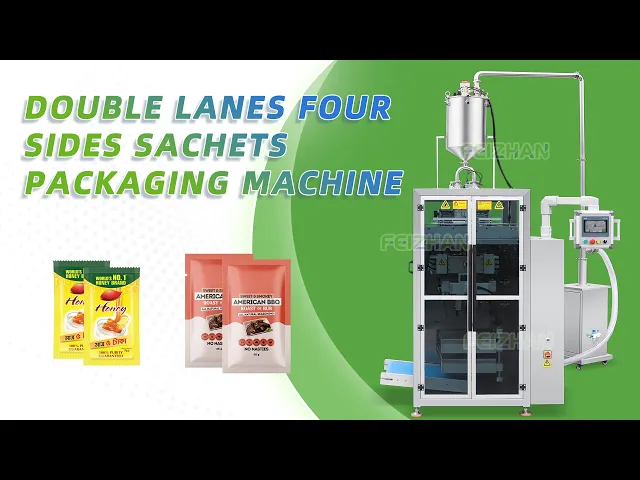
Multi-Lane Food Sachet Filling and Sealing Machine for Liquid Condiments Packaging
Product Overview
The FEIZHAN food sachet packaging machine fills and seals single-serve condiments — honey, syrup, ketchup, mustard, salad dressing, BBQ sauce, caramel. Pouch forming, dosing, filling, sealing, and cutting run as one continuous sequence. Date coding is optional. Lane count scales from 2 up to 12, depending on volume requirements.
Filling runs through pneumatic ceramic piston pumps with anti-drip valves. The ceramic surface resists wear from acidic or abrasive condiments better than metal alternatives. The anti-drip valve keeps excess product off the seal area — because a contaminated seal is a weak seal, regardless of how accurate the dose was.
Supply stays stable through a pressurized hopper, with an automatic feeding system available for high-volume runs. Low-viscosity sauces and thick syrups both move through the same system without requiring a mechanical changeover between product types.
All product-contact parts are food-grade 316 stainless steel — the grade that holds up against the cleaning agents and product acidity common in condiment production.
Film tension runs through a servo-driven feeding system. That control determines two things simultaneously: pouch length accuracy and seal quality — both depend on consistent tension as the film moves through the line, not just at the sealing station itself.
Control runs through a Siemens PLC. Recipe storage means a changeover between honey and BBQ sauce doesn't require re-entering parameters from scratch. Diagnostics and alarms flag problems before they become wasted product.
Four-side, three-side, or back-seal — sachet format is configurable. Output reaches up to 100 sachets per minute.
For condiment producers running multiple SKUs or planning volume growth, the lane and format flexibility tends to matter as much as the raw speed number.

Machine Features
Lane Count Scales With Volume
2, 4, 6, 10, or 12 lanes — the configuration depends on required output, not a fixed default. Lanes run simultaneously, which means doubling lane count roughly doubles throughput without doubling floor space. Filling accuracy and seal quality don't degrade as lane count increases; each lane operates as its own independent filling station.
Ceramic Piston Filling, 1–12 ml Range
Pneumatic ceramic pistons handle the dosing. Ceramic wears slower than metal under repeated cycling — which matters most at high lane counts and continuous multi-shift runs, where a metal piston's tolerance would drift over months of operation. Honey, syrup, sauces, condiments — viscosity range is broad, dosing tolerance stays tight.
Anti-Drip Valves
Excess product doesn't reach the seal area. That's the entire function. A drip at the seal point doesn't just waste material — it creates a weak spot exactly where the package needs to be strongest. Removing the drip removes that failure point before it happens.
316 Stainless Steel, Product-Contact Surfaces
316 over 304 for one reason: corrosion resistance against the acids and cleaning agents condiment and food production involves. Surfaces that resist corrosion also clean faster and more completely between runs — a practical benefit, not just a compliance checkbox.
Servo Film Feeding With Photoelectric Tracking
A servo motor pulls film; photoelectric sensors confirm position in real time. The combination keeps pouch length and seal alignment consistent — including at high lane counts and high speeds, where tracking drift would otherwise show up first.
Siemens PLC Control
Recipe storage, self-diagnostics, production monitoring, fault alarms. Switching from one product's parameters to another happens at the panel — no manual recalibration required. Faults get flagged before they turn into a run of rejected sachets.
Applications
The machine is suitable for packaging a wide variety of liquid and semi-liquid food products, including:
- Honey
- Syrup
- Caramel Syrup
- Chocolate Sauce
- Ketchup
- Mustard
- BBQ Sauce
- Salad Dressing
- Jam
- Fruit Sauce
- Condiments
- Liquid Sweeteners
- Flavor Concentrates
- Nutritional Supplements

Machine Parameter
|
Machine Model |
FZ-FS350Y-2 |
|
Power Supply |
AC 380V / 50Hz / 60Hz |
|
Power Consumption |
6.8 kW |
|
Packaging Type |
Four-side seal |
|
Dosing Method |
Pneumatic ceramic piston pump(Customizable as needed) |
|
Filling Range |
1-12 ml |
|
Filling Accuracy |
±5-7% (depending on product and packaging material) |
|
Bag Length |
40-180 mm |
|
Bag Width |
60 mm |
|
Packaging Speed |
(30-50)*2 lane=60-100 bags/min (depending on product and packaging material) |
|
Optional Function |
Date Coding, Easy-tear Notch & Vacuum Feeding |
|
Air Pressure Requirement |
≥0.6 MPa |
|
Machine Size |
About 2600*2000*3000mm(L*W*H) |
|
Machine Weight |
About 800 kg |
|
Package Size |
About 2390*1750*2170mm(L*W*H) |
|
Package Weight |
About 1200kg |

Detailed Machine Features


A pneumatic ceramic piston pump handles dosing across the 1–12 ml range. Anti-drip valves keep excess product off the seal area — waste drops, and the seal forms on a clean surface instead of a contaminated one.

Film alignment is what keeps multiple lanes producing identical sachets. The separation structure holds each lane's film path independent of the others — without it, lanes drift, and sachet dimensions start to vary from one lane to the next.

Compressed air drives the cutting blade — clean separation, no tearing or ragged edges at the cut line. Edge quality affects more than appearance; a rough cut can compromise the seal directly adjacent to it.Easy-tear notches are optional. For single-serve products people open by hand — honey, condiments, sauces, beverage syrups — a notch means the package opens at the intended point rather than wherever it happens to tear.

Batch numbers, manufacturing dates, expiration dates — printed directly onto each sachet, optionally, as part of the production cycle.

Photoelectric sensors detect registration marks on the film; the servo motor adjusts feed length in response — automatically, continuously, without operator input during the run.That detection loop is what keeps three things aligned at once: pouch length, printed artwork position, and seal placement. At low speed, drift is forgiving. At high speed, even a fraction-of-a-second lag between detection and correction shows up as a misaligned label or an off-center seal.

A level sensor monitors hopper content; when it drops below threshold, the optional piston feeder replenishes automatically — no operator topping off material mid-run.

How Does the Machine Work?
Step 1: Product Feeding
Food products are transferred from the feeding system into the pressurized hopper.
Step 2: Automatic Dosing
The ceramic piston pumps measure the preset filling volume accurately.
Step 3: Film Forming
Packaging film is automatically guided and formed into sachets.
Step 4: Product Filling
Measured product is filled into each sachet through the filling nozzles.
Step 5: Heat Sealing
Vertical and horizontal sealing units create secure and leak-resistant seals.
Step 6: Date Coding
Optional coding equipment prints batch numbers and production dates.
Step 7: Sachet Cutting and Discharge
Finished sachets are cut and conveyed to the collection area.
Why Choose This Machine?
Output Scales With Lanes, Not Headcount
Each lane runs as its own independent filling station. Adding lanes multiplies throughput without multiplying the operator count needed to run the line — at 12 lanes, output reaches levels manual filling simply can't approach.
Less Honey, Less Syrup, Less Lost in the Process
Anti-drip valves and precise piston dosing mean less product ends up wasted at the seal or overfilled past the target weight. For high-cost ingredients like honey, that recovered margin compounds across a full production run.
Every Sachet Matches the One Before It
Servo-controlled film feeding keeps pouch dimensions consistent — lane to lane, sachet to sachet. On a retail shelf, uniformity reads as quality control. Variation reads as the opposite, even when the product inside is identical.
Built for What Actually Resists Pumping
Honey, syrup, sauces, dressings — these don't move through a standard liquid filling system the way water does. The ceramic piston pump is specifically suited to viscosity in this range, where lower-grade pumps would struggle with consistent dosing.
Fewer Hands on the Line
Automatic operation removes the manual filling and sealing steps that would otherwise require dedicated operators at each station. The labor that remains shifts toward monitoring and changeovers — a different kind of work, not just less of it.
One Machine, Multiple Formats
Four-side, three-side, back-seal — sealing style is configurable rather than fixed. For manufacturers running multiple SKUs or anticipating format changes, that flexibility avoids a second equipment purchase down the line.
Optional Customizations
- 4 / 6 / 10 / 12 Lane Configurations
- Different Filling Volume Ranges
- Date Coding System
- Easy-Tear Notch Device
- Automatic Feeding System
- Stainless Steel Hopper Upgrades
- Explosion-Proof Configuration
- Custom Sachet Dimensions
- Customized Sealing Patterns
- Conveyor and Collection Systems
Frequently Asked Questions
What products can this machine package?
Honey, syrup, sauces, condiments, salad dressings, liquid sweeteners — most liquid and semi-liquid food products fall within range.
What filling range does the machine support?
Standard range is 1 to 12 ml. Wider or narrower ranges can be specified for specific applications.
Can it handle viscous products?
Yes. The ceramic piston system is built around medium- to high-viscosity products specifically — honey and thick syrups run without the dosing drift a standard pump would show.
What packaging styles are available?
Four-side, three-side, or back-seal. Format is selectable based on the product and intended retail presentation.
What is the production speed?
Up to 100 sachets per minute. The figure shifts somewhat depending on product viscosity and film material — denser products and certain film types run slightly slower.
Are product-contact parts food grade?
Yes. 316 stainless steel throughout — the grade specified for resistance against food acids and cleaning agents.
Can I add date coding?
Yes, as an optional system. Production dates, expiration dates, and batch numbers print directly onto each sachet.
Can the machine be customized?
Yes. Lane count, filling range, sachet dimensions, and additional functions can all be adjusted to match a specific application.
Is installation support available?
Yes. Operation guidance, technical support, and after-sales assistance are included.
What information should I provide before purchasing?
Product type, filling volume, sachet dimensions, target output, and packaging material — these five details let us match the right configuration to your application.
FEIZHAN
Multi-Lane Food Sachet Filling and Sealing Machine for Liquid Condiments Packaging
$26,999.00
Product Overview
The FEIZHAN food sachet packaging machine fills and seals single-serve condiments — honey, syrup, ketchup, mustard, salad dressing, BBQ sauce, caramel. Pouch forming, dosing, filling, sealing, and cutting run as one continuous sequence. Date coding is optional. Lane count scales from 2 up to 12, depending on volume requirements.
Filling runs through pneumatic ceramic piston pumps with anti-drip valves. The ceramic surface resists wear from acidic or abrasive condiments better than metal alternatives. The anti-drip valve keeps excess product off the seal area — because a contaminated seal is a weak seal, regardless of how accurate the dose was.
Supply stays stable through a pressurized hopper, with an automatic feeding system available for high-volume runs. Low-viscosity sauces and thick syrups both move through the same system without requiring a mechanical changeover between product types.
All product-contact parts are food-grade 316 stainless steel — the grade that holds up against the cleaning agents and product acidity common in condiment production.
Film tension runs through a servo-driven feeding system. That control determines two things simultaneously: pouch length accuracy and seal quality — both depend on consistent tension as the film moves through the line, not just at the sealing station itself.
Control runs through a Siemens PLC. Recipe storage means a changeover between honey and BBQ sauce doesn't require re-entering parameters from scratch. Diagnostics and alarms flag problems before they become wasted product.
Four-side, three-side, or back-seal — sachet format is configurable. Output reaches up to 100 sachets per minute.
For condiment producers running multiple SKUs or planning volume growth, the lane and format flexibility tends to matter as much as the raw speed number.
Machine Features
Lane Count Scales With Volume
2, 4, 6, 10, or 12 lanes — the configuration depends on required output, not a fixed default. Lanes run simultaneously, which means doubling lane count roughly doubles throughput without doubling floor space. Filling accuracy and seal quality don't degrade as lane count increases; each lane operates as its own independent filling station.
Ceramic Piston Filling, 1–12 ml Range
Pneumatic ceramic pistons handle the dosing. Ceramic wears slower than metal under repeated cycling — which matters most at high lane counts and continuous multi-shift runs, where a metal piston's tolerance would drift over months of operation. Honey, syrup, sauces, condiments — viscosity range is broad, dosing tolerance stays tight.
Anti-Drip Valves
Excess product doesn't reach the seal area. That's the entire function. A drip at the seal point doesn't just waste material — it creates a weak spot exactly where the package needs to be strongest. Removing the drip removes that failure point before it happens.
316 Stainless Steel, Product-Contact Surfaces
316 over 304 for one reason: corrosion resistance against the acids and cleaning agents condiment and food production involves. Surfaces that resist corrosion also clean faster and more completely between runs — a practical benefit, not just a compliance checkbox.
Servo Film Feeding With Photoelectric Tracking
A servo motor pulls film; photoelectric sensors confirm position in real time. The combination keeps pouch length and seal alignment consistent — including at high lane counts and high speeds, where tracking drift would otherwise show up first.
Siemens PLC Control
Recipe storage, self-diagnostics, production monitoring, fault alarms. Switching from one product's parameters to another happens at the panel — no manual recalibration required. Faults get flagged before they turn into a run of rejected sachets.
Applications
The machine is suitable for packaging a wide variety of liquid and semi-liquid food products, including:
- Honey
- Syrup
- Caramel Syrup
- Chocolate Sauce
- Ketchup
- Mustard
- BBQ Sauce
- Salad Dressing
- Jam
- Fruit Sauce
- Condiments
- Liquid Sweeteners
- Flavor Concentrates
- Nutritional Supplements
Machine Parameter
|
Machine Model |
FZ-FS350Y-2 |
|
Power Supply |
AC 380V / 50Hz / 60Hz |
|
Power Consumption |
6.8 kW |
|
Packaging Type |
Four-side seal |
|
Dosing Method |
Pneumatic ceramic piston pump(Customizable as needed) |
|
Filling Range |
1-12 ml |
|
Filling Accuracy |
±5-7% (depending on product and packaging material) |
|
Bag Length |
40-180 mm |
|
Bag Width |
60 mm |
|
Packaging Speed |
(30-50)*2 lane=60-100 bags/min (depending on product and packaging material) |
|
Optional Function |
Date Coding, Easy-tear Notch & Vacuum Feeding |
|
Air Pressure Requirement |
≥0.6 MPa |
|
Machine Size |
About 2600*2000*3000mm(L*W*H) |
|
Machine Weight |
About 800 kg |
|
Package Size |
About 2390*1750*2170mm(L*W*H) |
|
Package Weight |
About 1200kg |
Detailed Machine Features
A pneumatic ceramic piston pump handles dosing across the 1–12 ml range. Anti-drip valves keep excess product off the seal area — waste drops, and the seal forms on a clean surface instead of a contaminated one.
Film alignment is what keeps multiple lanes producing identical sachets. The separation structure holds each lane's film path independent of the others — without it, lanes drift, and sachet dimensions start to vary from one lane to the next.
Compressed air drives the cutting blade — clean separation, no tearing or ragged edges at the cut line. Edge quality affects more than appearance; a rough cut can compromise the seal directly adjacent to it.Easy-tear notches are optional. For single-serve products people open by hand — honey, condiments, sauces, beverage syrups — a notch means the package opens at the intended point rather than wherever it happens to tear.
Batch numbers, manufacturing dates, expiration dates — printed directly onto each sachet, optionally, as part of the production cycle.
Photoelectric sensors detect registration marks on the film; the servo motor adjusts feed length in response — automatically, continuously, without operator input during the run.That detection loop is what keeps three things aligned at once: pouch length, printed artwork position, and seal placement. At low speed, drift is forgiving. At high speed, even a fraction-of-a-second lag between detection and correction shows up as a misaligned label or an off-center seal.
A level sensor monitors hopper content; when it drops below threshold, the optional piston feeder replenishes automatically — no operator topping off material mid-run.
How Does the Machine Work?
Step 1: Product Feeding
Food products are transferred from the feeding system into the pressurized hopper.
Step 2: Automatic Dosing
The ceramic piston pumps measure the preset filling volume accurately.
Step 3: Film Forming
Packaging film is automatically guided and formed into sachets.
Step 4: Product Filling
Measured product is filled into each sachet through the filling nozzles.
Step 5: Heat Sealing
Vertical and horizontal sealing units create secure and leak-resistant seals.
Step 6: Date Coding
Optional coding equipment prints batch numbers and production dates.
Step 7: Sachet Cutting and Discharge
Finished sachets are cut and conveyed to the collection area.
Why Choose This Machine?
Output Scales With Lanes, Not Headcount
Each lane runs as its own independent filling station. Adding lanes multiplies throughput without multiplying the operator count needed to run the line — at 12 lanes, output reaches levels manual filling simply can't approach.
Less Honey, Less Syrup, Less Lost in the Process
Anti-drip valves and precise piston dosing mean less product ends up wasted at the seal or overfilled past the target weight. For high-cost ingredients like honey, that recovered margin compounds across a full production run.
Every Sachet Matches the One Before It
Servo-controlled film feeding keeps pouch dimensions consistent — lane to lane, sachet to sachet. On a retail shelf, uniformity reads as quality control. Variation reads as the opposite, even when the product inside is identical.
Built for What Actually Resists Pumping
Honey, syrup, sauces, dressings — these don't move through a standard liquid filling system the way water does. The ceramic piston pump is specifically suited to viscosity in this range, where lower-grade pumps would struggle with consistent dosing.
Fewer Hands on the Line
Automatic operation removes the manual filling and sealing steps that would otherwise require dedicated operators at each station. The labor that remains shifts toward monitoring and changeovers — a different kind of work, not just less of it.
One Machine, Multiple Formats
Four-side, three-side, back-seal — sealing style is configurable rather than fixed. For manufacturers running multiple SKUs or anticipating format changes, that flexibility avoids a second equipment purchase down the line.
Optional Customizations
- 4 / 6 / 10 / 12 Lane Configurations
- Different Filling Volume Ranges
- Date Coding System
- Easy-Tear Notch Device
- Automatic Feeding System
- Stainless Steel Hopper Upgrades
- Explosion-Proof Configuration
- Custom Sachet Dimensions
- Customized Sealing Patterns
- Conveyor and Collection Systems
Frequently Asked Questions
What products can this machine package?
Honey, syrup, sauces, condiments, salad dressings, liquid sweeteners — most liquid and semi-liquid food products fall within range.
What filling range does the machine support?
Standard range is 1 to 12 ml. Wider or narrower ranges can be specified for specific applications.
Can it handle viscous products?
Yes. The ceramic piston system is built around medium- to high-viscosity products specifically — honey and thick syrups run without the dosing drift a standard pump would show.
What packaging styles are available?
Four-side, three-side, or back-seal. Format is selectable based on the product and intended retail presentation.
What is the production speed?
Up to 100 sachets per minute. The figure shifts somewhat depending on product viscosity and film material — denser products and certain film types run slightly slower.
Are product-contact parts food grade?
Yes. 316 stainless steel throughout — the grade specified for resistance against food acids and cleaning agents.
Can I add date coding?
Yes, as an optional system. Production dates, expiration dates, and batch numbers print directly onto each sachet.
Can the machine be customized?
Yes. Lane count, filling range, sachet dimensions, and additional functions can all be adjusted to match a specific application.
Is installation support available?
Yes. Operation guidance, technical support, and after-sales assistance are included.
What information should I provide before purchasing?
Product type, filling volume, sachet dimensions, target output, and packaging material — these five details let us match the right configuration to your application.
$26,999.00
$26,999.00
- Choosing a selection results in a full page refresh.
- Opens in a new window.