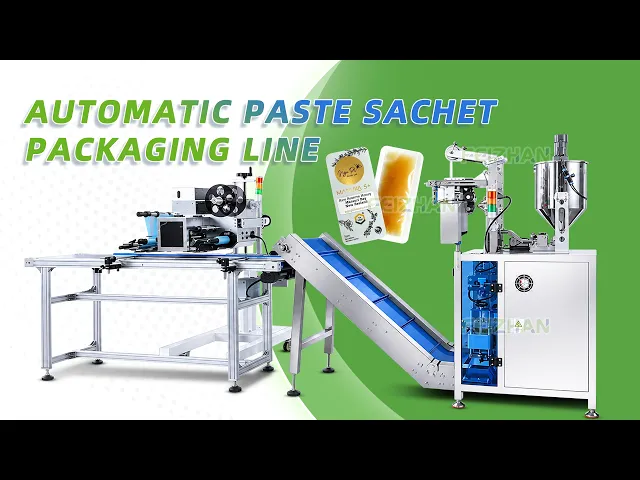
Product Description
The Automatic Sauce Sachet Packaging Line combines a VFFS sachet packaging machine with an automatic label printing and labeling machine — filling, sealing, and labeling run as one continuous sequence without manual transfer between the two machines.
A servo gear pump drives the fill. Gear pump operation is continuous rather than stroke-based, which suits viscous products — sauces, honey, jam, mayonnaise, chocolate sauce — where consistent pressure across a long run matters more than cycle-by-cycle displacement precision. A stainless steel hopper supplies the pump continuously; for products that separate or settle at rest, the hopper keeps material composition consistent at the pump inlet across a full production run.
Finished sachets transfer automatically to the labeling station after sealing. Labels print and apply inline — production dates, batch numbers, barcodes, QR codes — at the unit level, which gives traceability down to the individual sachet rather than the outer carton.
Full-electric operation removes the compressed air line requirement and the compressor maintenance that pneumatic systems add. Package format, fill volume, and label content customize to match the product and the market it's going into.
Machine Features
- Complete VFFS filling, sealing and labeling solution
- Servo gear pump for accurate filling
- Food-grade stainless steel contact parts
- Full-electric operation without air compressor
- Supports label printing with variable data
- Compatible with multiple sachet sizes
- Stable packaging for viscous food products
- Customizable filling range and sealing style

Applications
Suitable Products
- Tomato Sauce
- Chili Sauce
- Soy Sauce
- Honey
- Jam
- Chocolate Sauce
- Peanut Butter
- Mayonnaise
- Salad Dressing
- Syrup
- Cheese Sauce
- Condensed Milk
- Fruit Puree
- Cooking Paste
Package Types
- Flat Sachet
- Side Seal Sachet
- Three-side Seal Sachet
- Four-side Seal Sachet
- Customized Sachet

Machine Parameters
Sachet Packaging Machine
|
Machine Model
|
FZ-FP220E
|
|
Machine Voltage
|
110/220V 50-60 HZ
|
|
Power
|
2.5 KW
|
|
Metering Method
|
Servo Gear Pump
|
|
Packaging Form
|
Can Be Customized
|
|
Dosage Range
|
Can Be Customized
|
|
Hopper Size
|
30L(With mixer)
|
|
Bag Size
|
Length 20-145 mm, Bag width 20-110 mm
|
|
Packaging Speed
|
60-90 Bags/Minute (Depending on the actual material)
|
|
Machine Size
|
900*700*1720 mm
|
|
Machine Weight
|
250 KG
|
|
Package Size
|
1060*780*1750 mm(Packaging machine)
1650*650*1550 mm(Conveyor)
|
|
Package Weight
|
305+93=398 kg
|

Cache Printing Labeling Machine
|
Machine Model
|
FZ-TB160POPB
|
|
Power Supply
|
110/220V 50-60 HZ, 600 W
|
|
Printing Method
|
Thermal transfer/thermal sensitive
|
|
Printing Resolution
|
200 dpi / 300 dpi
|
|
Printing Speed
|
2-10 inches/S / 2-7 inches/S
|
|
Printing Range
|
25-180 mm(L)*25-104 mm(W)
|
|
Paper Roll Size
|
ID= Φ76 mm, OD=250 mm
|
|
Backing Paper Size
|
25.4-106mm(W) *0.06-0.30mm(thickness)
|
|
Ribbon
|
450m(L)* 25-110mm(W), Max OD=90mm
(when winding the ribbon, the coated side faces outward)
|
|
Connection Size
|
USB 2.0 / network port
|
|
Labeling Speed
|
10-25 pcs/min
|
|
Labeling Accuracy
|
±1-3 mm (excluding product and label errors)
|
|
Label Size
|
25-180 mm(W)*25-104 mm(H)
|
|
Print Content
|
Text, serial number, date, pattern, one (two-dimensional) barcode and other identifications
|
|
Package Size
|
2150*1260*1810 mm
|
|
Package Weight
|
315 kg
|

Machine Details
PLC Touchscreen Control
Operators adjust filling volume, sealing temperature, and other parameters directly through the interface. Recipe management sits here too, so switching between products doesn't mean resetting everything manually — just loading whatever's already saved.
Food-Grade Mixing Hopper
Stainless steel construction, built to keep product moving smoothly right up until it reaches the filler. For thicker materials — honey, sauces, jam — optional mixing and heating functions handle the viscosity issue directly, rather than leaving product to thicken and stall inside the hopper.
Servo Gear Pump Filling
Handles a range of viscosities without needing separate equipment for each. The servo control adds precision on top of the gear pump's steady flow, so adjusting between different filling volumes stays straightforward — no major recalibration required each time the product changes.
Automatic VFFS Packaging
Forms the sachet, fills it, seals it, cuts it — one continuous sequence, no manual handoff between stages. That continuity is really what drives consistency here; fewer interruptions mean fewer opportunities for variation batch to batch.
Automatic Product Transfer
Finished sachets move straight to labeling, no manual carrying between stations. Reduces handling, keeps production continuous, and cuts down the opportunities for contamination or damage that come with extra manual steps.
Thermal Transfer Label Printing
Prints variable information — production dates, batch numbers, barcodes, QR codes — directly before labels apply. Keeps traceability data current and accurate for every batch, without a separate coding step slowing things down.
Precise Flat Labeling
The flat labeling mechanism places labels accurately, and a brush system works through afterward to push out air bubbles — the kind that otherwise leave a label looking slightly lifted or uneven.

How Does the Machine Work?
Step 1
Feed food products into the hopper.
Step 2
The servo gear pump measures the preset filling volume.
Step 3
The VFFS machine forms sachets, fills products and seals each package.
Step 4
Finished sachets are transferred automatically by conveyor.
Step 5
Labels are printed with production information.
Step 6
Labels are applied to finished sachets before product collection.
Why Choose This Machine?
- Designed for automatic food sachet production
- Suitable for sauces and other viscous food products
- Accurate servo gear pump filling
- Supports traceable label printing
- Continuous filling, sealing and labeling workflow
- Food-grade contact parts for hygienic production
- Customizable package sizes and filling volumes
- Easily integrated into automatic packaging lines
Frequently Asked Questions
What food products can this packaging line handle?
Sauces, honey, jam, mayonnaise, peanut butter, chocolate sauce, syrups — really, most viscous food products fall within its range. The mixing hopper and servo gear pump combination is what makes that breadth possible, honestly, rather than the line being tuned narrowly for just one product type.
Can the filling volume be customized?
Yes. The filling range can be customized according to your product and package requirements — different sachet sizes, different fill weights, adjusted case by case rather than fixed at manufacture.
Does the machine require an air compressor?
No. Full-electric design here, so there's no external air compressor to install, maintain, or budget for separately.
What types of sachets can be produced?
Side-seal sachets, as the standard configuration. Beyond that, sealing style and package size can be customized further, depending on what a given product line actually needs.
Can production information be printed on the labels?
Yes. Production dates, batch numbers, barcodes, QR codes, general text — all supported as variable information, applied fresh to each batch rather than requiring separate manual coding.
Can the machine be connected with other production equipment?
Yes. Fits into a broader line, upstream or downstream — feeding equipment ahead of it, or cartoning, case packing, palletizing systems after. Not built as a standalone island, in other words.
Is this machine suitable for high-viscosity food products?
Yes. Honey, peanut butter, chocolate sauce, thick condiments generally — the servo gear pump plus optional mixing hopper are specifically designed with these in mind, not adapted afterward as an afterthought.
What information should I provide for machine customization?
A few details help narrow the spec accurately:
- Product type and viscosity
- Filling volume
- Sachet dimensions
- Packaging film
- Required production capacity
- Label size
- Power supply
- Special customization requirements
Worth gathering these upfront, honestly, rather than starting with a generic configuration and adjusting after the fact — saves both time and cost once the actual build begins.