



FEIZHAN
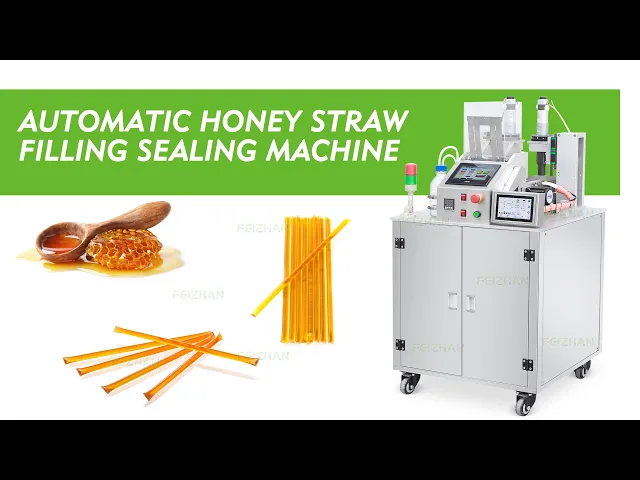
Automatic Honey Straw Filling Sealing Machine | Honey Stick Packaging Solutions
Product Overview
The Automatic Honey Straw Filling Sealing Machine packages honey into single-serve straws — feeding, filling, recovering excess material, and sealing, all in one sequence. Output reaches 2,500 to 3,000 pieces per hour.
Filling runs through a food-grade peristaltic pump. The product contacts only the tubing — nothing else in the system touches the liquid directly. That narrows what needs cleaning between runs and reduces the surface area where contamination risk lives.
Sealing uses ultrasonic technology. The seal forms through heat generated by vibration rather than direct contact with a heating element — producing a seal that holds through transport, storage, and shelf handling without weak points at the edges.
Honey is the obvious application, but the mechanism doesn't care what's viscous. Glucose syrup, liquid sweeteners, nutritional gels, edible oils — anything that flows through a peristaltic pump and seals cleanly under ultrasonic pressure fits the same production line.

Machine Features
Automatic Straw Feeding System
The machine automatically feeds empty straws into the working position, reducing manual labor and ensuring stable production. The feeding structure can store multiple straws for continuous operation, helping manufacturers improve productivity.
Peristaltic Pump Filling Technology
The food-grade peristaltic pump allows liquid to flow only through the tubing, ensuring hygienic filling and reducing cleaning requirements. This design is particularly suitable for food manufacturers processing honey and other viscous products.
Three Filling Nozzles
Three filling nozzles work simultaneously to increase production efficiency while maintaining consistent filling accuracy, making the machine suitable for medium and large-scale production requirements.
Material Recovery Structure
The integrated suction-back system automatically removes excess product after filling. This helps prevent dripping, keeps sealing areas clean, and reduces valuable product waste.
Ultrasonic Sealing Technology
Using ultrasonic sealing technology, the machine creates strong, neat, and reliable seals. The sealing process helps prevent leakage and improves the appearance of finished honey straws.
Touchscreen Control System
The user-friendly touchscreen interface allows operators to adjust parameters easily. Multiple language options are available to accommodate global production environments.
Applications
This machine is suitable for packaging various liquid and semi-liquid products into plastic straws.
Food Industry
- Honey Straws
- Honey Sticks
- Glucose Syrup
- Liquid Sweeteners
- Nutritional Gels
- Energy Gels
- Edible Oils
- Functional Food Products
Other Industries
- Glow Sticks
- Promotional Liquid Samples
- Specialty Liquid Products
The flexible filling system makes the machine suitable for businesses seeking convenient single-serve packaging solutions.

Honey Straw Filling Machine Parameter
|
Machine Model |
FZ-FSHS21 |
|
Voltage |
220V, 50-60 Hz |
|
Power |
3kW |
|
Working Speed |
About 2500-3000 pcs/h (Depending on Straw Size) |
|
Filling Pump |
Peristaltic Pump |
|
Flow Rate of Pump |
0-1140 ml/min |
|
Sealing Method |
Ultrasonic Sealing |
|
Ultrasonic Frequency |
20 kHz |
|
Original Straw Length |
197 mm(can be customized) |
|
Finished Straw Length |
172 mm(can be customized) |
|
Machine Size |
About 750*700*1370 mm/ About 29.5*27.6*53.9 inch |

Machine Detail

The touchscreen control system allows operators to adjust filling parameters quickly and monitor production status in real time. Multiple language options are available, reducing training requirements and helping manufacturers achieve faster production setup.

Automatic Straw Feeding System
Empty straws move continuously into position through an automatic feeding structure — no operator placing straws by hand between cycles.
The feeding magazine holds up to 500 straws at once. At full production speed, that's roughly 10 to 12 minutes of run time before reloading — enough to keep an operator focused on other tasks rather than constant feeding.

Hygienic Peristaltic Pump Filling System
Honey flows through tubing only — never touching the pump's internal components directly. The pump compresses the tube from outside, pushing product through without the liquid ever contacting metal or mechanical parts.
That separation matters for cleaning. Swap the tubing between product runs, or between cleaning cycles, and the contact surfaces are addressed. No disassembling pump housings, no scrubbing internal components that honey has been sitting against.
For honey specifically — viscous, prone to residue buildup, difficult to fully rinse from tight mechanical spaces — that simplification isn't incidental. It's often the deciding factor in equipment selection.

Material Recovery Container for Reduced Product Loss
Excess honey doesn't go to waste — a dedicated recovery container catches it during operation, separate from the main product flow.
For low-cost ingredients, that recovered material might not be worth the effort. For natural honey, organic syrups, nutritional gels, specialty concentrates — products where raw material cost is a significant line item — recovering even small percentages adds up across a production run.

Ultrasonic Sealing for Leak-Proof Packaging
No heating element touches the straw directly. Instead, high-frequency vibration generates friction at the seal point — and that friction generates the heat that fuses the material together.
The result holds up under handling. Transport, storage, retail shelf time — each adds stress to a seal, and a weak point anywhere along the edge becomes a leak waiting to happen. Ultrasonic sealing forms the bond evenly across the full seal width, without the hot spots and cold spots that direct-contact heating can produce.
For a liquid product like honey, that evenness is the difference between a straw that survives the supply chain and one that doesn't.

How Does the Machine Work?
Step 1: Straw Feeding
Empty straws enter the working area through the feeding structure — continuous, no manual placement.
Step 2: Straw Positioning
Each straw gets aligned before filling starts. Position matters here — a straw that's even slightly off-axis can cause uneven fill or a weak seal downstream.
Step 3: Liquid Filling
The peristaltic pump pushes product through three filling nozzles simultaneously. Three straws fill per cycle, not one — a meaningful factor in how the 2,500-3,000/hour output is reached.
Step 4: Excess Material Recovery
Before sealing, any excess gets sucked back. This isn't just about avoiding drips — a wet sealing surface is a weak seal. Removing the excess first means the seal forms on clean, dry material.
Step 5: Ultrasonic Sealing
Both ends seal through ultrasonic vibration. The result: no gaps, no weak points, nothing for the product to seep through during transport or storage.
Step 6: Finished Product Output
Sealed straws discharge automatically — ready for collection, secondary packaging, or direct shipment.
Why Choose This Machine?
Fewer Contact Points, Lower Contamination Risk
The peristaltic pump keeps honey inside the tubing — never touching pump components directly. Fewer surfaces in contact with product means fewer surfaces that need cleaning, and fewer points where contamination can enter.
Less Honey Lost to the Process Itself
Excess product gets recovered rather than discarded. For natural honey or nutritional syrups — ingredients with real per-kilogram cost — that recovery isn't a minor efficiency. Over a full production run, it adds up to a measurable difference in raw material spend.
Output Without Adding Hands
Feeding, filling, and sealing run without manual intervention at any step. Output scales with machine speed, not with how many operators are stationed along the line.
The Seal Determines the Outcome
Fill accuracy and seal integrity aren't separate concerns — they compound. A precisely filled straw with a weak seal still leaks. A perfect seal on an underfilled straw still shorts the customer. Getting both right, consistently, is what keeps every unit on shelf matching the one before it.
Where the Cost Savings Actually Come From
Two things drive down operating cost here: less labor needed per unit produced, and less raw material lost in the process. Neither shows up as a single line item — both compound across volume.
A Seal That Holds Through the Supply Chain
Ultrasonic sealing forms a bond without hot spots or weak edges. That matters most after the product leaves the facility — during transport, storage, and shelf time, when nobody's there to catch a failure before it reaches the customer.
The Format Itself Is Growing
Single-serve packaging isn't a niche anymore. Convenience, portability, portion control — these drivers extend well beyond honey, and brands positioning into this format are responding to a shift in how consumers buy, not just a packaging trend.
Frequently Asked Questions
What products can this machine fill?
Honey, glucose syrup, liquid sweeteners, edible oils, nutritional gels — most liquid and semi-liquid products fall within range.
Is it suitable for thick honey?
Yes. Viscosity is what the peristaltic pump system is built around — natural honey and concentrated syrups run without issue.
What is the production capacity?
Roughly 2,500 to 3,000 pieces per hour. The exact figure shifts slightly depending on product viscosity and straw specifications.
What filling technology does the machine use?
A peristaltic pump. Product moves through tubing only, which keeps the dispensing accurate and the contact surfaces minimal.
How does the machine prevent product waste?
Excess product gets sucked back after filling — before it can drip or interfere with the sealing surface.
Why use ultrasonic sealing?
Vibration generates the seal, not direct heat. The result is an even bond across the seal edge — fewer weak points, less leakage risk.
Can straw length be customized?
Yes. Straw length can be specified to match production requirements.
Is the machine easy to operate?
The touchscreen interface handles settings and language selection. Day-to-day operation doesn't require specialized technical training.
Can the machine be used for products other than honey?
Yes. Syrups, glucose solutions, nutritional gels, edible oils — anything within the pump's viscosity range works.
Do you provide technical support?
Yes. Technical support and after-sales service are available — covering setup, operation, and ongoing production questions.
FEIZHAN
Automatic Honey Straw Filling Sealing Machine | Honey Stick Packaging Solutions
$24,999.00
Product Overview
The Automatic Honey Straw Filling Sealing Machine packages honey into single-serve straws — feeding, filling, recovering excess material, and sealing, all in one sequence. Output reaches 2,500 to 3,000 pieces per hour.
Filling runs through a food-grade peristaltic pump. The product contacts only the tubing — nothing else in the system touches the liquid directly. That narrows what needs cleaning between runs and reduces the surface area where contamination risk lives.
Sealing uses ultrasonic technology. The seal forms through heat generated by vibration rather than direct contact with a heating element — producing a seal that holds through transport, storage, and shelf handling without weak points at the edges.
Honey is the obvious application, but the mechanism doesn't care what's viscous. Glucose syrup, liquid sweeteners, nutritional gels, edible oils — anything that flows through a peristaltic pump and seals cleanly under ultrasonic pressure fits the same production line.
Machine Features
Automatic Straw Feeding System
The machine automatically feeds empty straws into the working position, reducing manual labor and ensuring stable production. The feeding structure can store multiple straws for continuous operation, helping manufacturers improve productivity.
Peristaltic Pump Filling Technology
The food-grade peristaltic pump allows liquid to flow only through the tubing, ensuring hygienic filling and reducing cleaning requirements. This design is particularly suitable for food manufacturers processing honey and other viscous products.
Three Filling Nozzles
Three filling nozzles work simultaneously to increase production efficiency while maintaining consistent filling accuracy, making the machine suitable for medium and large-scale production requirements.
Material Recovery Structure
The integrated suction-back system automatically removes excess product after filling. This helps prevent dripping, keeps sealing areas clean, and reduces valuable product waste.
Ultrasonic Sealing Technology
Using ultrasonic sealing technology, the machine creates strong, neat, and reliable seals. The sealing process helps prevent leakage and improves the appearance of finished honey straws.
Touchscreen Control System
The user-friendly touchscreen interface allows operators to adjust parameters easily. Multiple language options are available to accommodate global production environments.
Applications
This machine is suitable for packaging various liquid and semi-liquid products into plastic straws.
Food Industry
- Honey Straws
- Honey Sticks
- Glucose Syrup
- Liquid Sweeteners
- Nutritional Gels
- Energy Gels
- Edible Oils
- Functional Food Products
Other Industries
- Glow Sticks
- Promotional Liquid Samples
- Specialty Liquid Products
The flexible filling system makes the machine suitable for businesses seeking convenient single-serve packaging solutions.
Honey Straw Filling Machine Parameter
|
Machine Model |
FZ-FSHS21 |
|
Voltage |
220V, 50-60 Hz |
|
Power |
3kW |
|
Working Speed |
About 2500-3000 pcs/h (Depending on Straw Size) |
|
Filling Pump |
Peristaltic Pump |
|
Flow Rate of Pump |
0-1140 ml/min |
|
Sealing Method |
Ultrasonic Sealing |
|
Ultrasonic Frequency |
20 kHz |
|
Original Straw Length |
197 mm(can be customized) |
|
Finished Straw Length |
172 mm(can be customized) |
|
Machine Size |
About 750*700*1370 mm/ About 29.5*27.6*53.9 inch |
Machine Detail
The touchscreen control system allows operators to adjust filling parameters quickly and monitor production status in real time. Multiple language options are available, reducing training requirements and helping manufacturers achieve faster production setup.
Automatic Straw Feeding System
Empty straws move continuously into position through an automatic feeding structure — no operator placing straws by hand between cycles.
The feeding magazine holds up to 500 straws at once. At full production speed, that's roughly 10 to 12 minutes of run time before reloading — enough to keep an operator focused on other tasks rather than constant feeding.
Hygienic Peristaltic Pump Filling System
Honey flows through tubing only — never touching the pump's internal components directly. The pump compresses the tube from outside, pushing product through without the liquid ever contacting metal or mechanical parts.
That separation matters for cleaning. Swap the tubing between product runs, or between cleaning cycles, and the contact surfaces are addressed. No disassembling pump housings, no scrubbing internal components that honey has been sitting against.
For honey specifically — viscous, prone to residue buildup, difficult to fully rinse from tight mechanical spaces — that simplification isn't incidental. It's often the deciding factor in equipment selection.
Material Recovery Container for Reduced Product Loss
Excess honey doesn't go to waste — a dedicated recovery container catches it during operation, separate from the main product flow.
For low-cost ingredients, that recovered material might not be worth the effort. For natural honey, organic syrups, nutritional gels, specialty concentrates — products where raw material cost is a significant line item — recovering even small percentages adds up across a production run.
Ultrasonic Sealing for Leak-Proof Packaging
No heating element touches the straw directly. Instead, high-frequency vibration generates friction at the seal point — and that friction generates the heat that fuses the material together.
The result holds up under handling. Transport, storage, retail shelf time — each adds stress to a seal, and a weak point anywhere along the edge becomes a leak waiting to happen. Ultrasonic sealing forms the bond evenly across the full seal width, without the hot spots and cold spots that direct-contact heating can produce.
For a liquid product like honey, that evenness is the difference between a straw that survives the supply chain and one that doesn't.
How Does the Machine Work?
Step 1: Straw Feeding
Empty straws enter the working area through the feeding structure — continuous, no manual placement.
Step 2: Straw Positioning
Each straw gets aligned before filling starts. Position matters here — a straw that's even slightly off-axis can cause uneven fill or a weak seal downstream.
Step 3: Liquid Filling
The peristaltic pump pushes product through three filling nozzles simultaneously. Three straws fill per cycle, not one — a meaningful factor in how the 2,500-3,000/hour output is reached.
Step 4: Excess Material Recovery
Before sealing, any excess gets sucked back. This isn't just about avoiding drips — a wet sealing surface is a weak seal. Removing the excess first means the seal forms on clean, dry material.
Step 5: Ultrasonic Sealing
Both ends seal through ultrasonic vibration. The result: no gaps, no weak points, nothing for the product to seep through during transport or storage.
Step 6: Finished Product Output
Sealed straws discharge automatically — ready for collection, secondary packaging, or direct shipment.
Why Choose This Machine?
Fewer Contact Points, Lower Contamination Risk
The peristaltic pump keeps honey inside the tubing — never touching pump components directly. Fewer surfaces in contact with product means fewer surfaces that need cleaning, and fewer points where contamination can enter.
Less Honey Lost to the Process Itself
Excess product gets recovered rather than discarded. For natural honey or nutritional syrups — ingredients with real per-kilogram cost — that recovery isn't a minor efficiency. Over a full production run, it adds up to a measurable difference in raw material spend.
Output Without Adding Hands
Feeding, filling, and sealing run without manual intervention at any step. Output scales with machine speed, not with how many operators are stationed along the line.
The Seal Determines the Outcome
Fill accuracy and seal integrity aren't separate concerns — they compound. A precisely filled straw with a weak seal still leaks. A perfect seal on an underfilled straw still shorts the customer. Getting both right, consistently, is what keeps every unit on shelf matching the one before it.
Where the Cost Savings Actually Come From
Two things drive down operating cost here: less labor needed per unit produced, and less raw material lost in the process. Neither shows up as a single line item — both compound across volume.
A Seal That Holds Through the Supply Chain
Ultrasonic sealing forms a bond without hot spots or weak edges. That matters most after the product leaves the facility — during transport, storage, and shelf time, when nobody's there to catch a failure before it reaches the customer.
The Format Itself Is Growing
Single-serve packaging isn't a niche anymore. Convenience, portability, portion control — these drivers extend well beyond honey, and brands positioning into this format are responding to a shift in how consumers buy, not just a packaging trend.
Frequently Asked Questions
What products can this machine fill?
Honey, glucose syrup, liquid sweeteners, edible oils, nutritional gels — most liquid and semi-liquid products fall within range.
Is it suitable for thick honey?
Yes. Viscosity is what the peristaltic pump system is built around — natural honey and concentrated syrups run without issue.
What is the production capacity?
Roughly 2,500 to 3,000 pieces per hour. The exact figure shifts slightly depending on product viscosity and straw specifications.
What filling technology does the machine use?
A peristaltic pump. Product moves through tubing only, which keeps the dispensing accurate and the contact surfaces minimal.
How does the machine prevent product waste?
Excess product gets sucked back after filling — before it can drip or interfere with the sealing surface.
Why use ultrasonic sealing?
Vibration generates the seal, not direct heat. The result is an even bond across the seal edge — fewer weak points, less leakage risk.
Can straw length be customized?
Yes. Straw length can be specified to match production requirements.
Is the machine easy to operate?
The touchscreen interface handles settings and language selection. Day-to-day operation doesn't require specialized technical training.
Can the machine be used for products other than honey?
Yes. Syrups, glucose solutions, nutritional gels, edible oils — anything within the pump's viscosity range works.
Do you provide technical support?
Yes. Technical support and after-sales service are available — covering setup, operation, and ongoing production questions.
$24,999.00
$24,999.00
- Choosing a selection results in a full page refresh.
- Opens in a new window.